I. From “Audible” to “Crisp and Clear”: The Modern Mission of Audio Power Amplifiers
Smart homes, wearable devices, industrial handheld terminals—as the Internet of Things (IoT) connects all devices, “sound” has been redefined as one of the most natural human-machine interaction methods. It is no longer about simple buzzer alerts, but rather clear voice feedback, high-fidelity background music, and even real-time AI voice conversations.
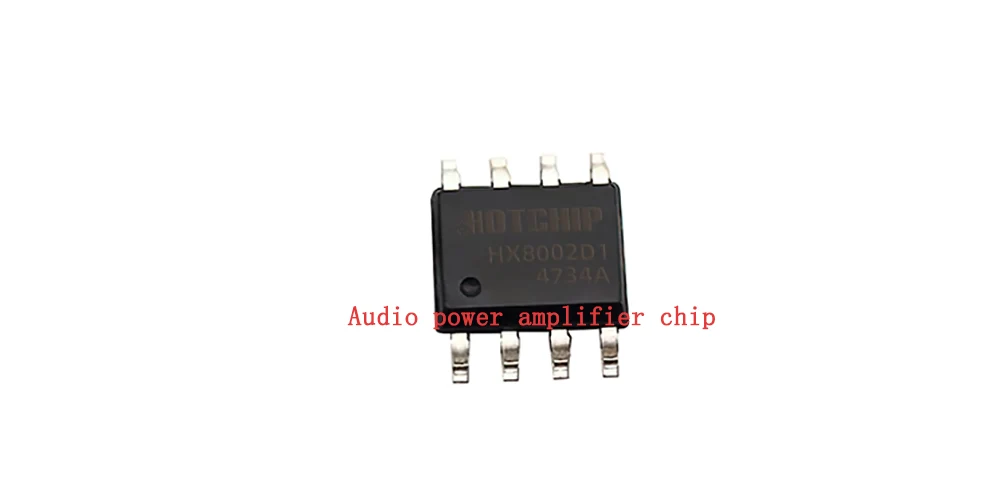
However, these devices share common challenges: compact form factors, battery power supply, and cost sensitivity. Traditional audio solutions often suffer from high power consumption, bulky peripheral circuits, or poor sound quality. The HX8002D1 from Hotchip precisely fills this gap. It is not designed for home theater systems, but to provide “clear, reliable, and easy-to-use” audio output capabilities for countless smart hardware devices. This article will explore three typical application scenarios to demonstrate how the HX8002D1 empowers “sound in everything.”
II. Scenario 1: Portable Bluetooth Speakers – Small Size, Big Soundstage
This is the most intuitive application. Mini Bluetooth speakers on the market are often limited by battery capacity and speaker size—loud volumes cause distortion, while low volumes sacrifice detail.
HX8002D1’s Solution:
Making the Most of Low-Impedance Speakers: To achieve sufficient bass and sound pressure within a small enclosure, speaker designers often opt for 4Ω or 3Ω drivers. With a 5V supply and a 3Ω load, the HX8002D1 delivers up to 2.8W of output power, allowing compact portable speakers to produce impressive sound levels.
Low Distortion for High-Quality Audio: At normal listening volumes (e.g., 0.5W–1W), the HX8002D1 achieves a Total Harmonic Distortion (THD) as low as 0.3% (at 1kHz). This ensures clear vocals, good instrument separation, and avoids the “muffled” sound often associated with traditional Class-AB amplifiers.
Differential Inputs for RF Interference Rejection: Bluetooth speakers internally contain multiple interference sources, including Bluetooth antennas, DC-DC boost converters, and digital signal processing circuits. The differential input architecture effectively suppresses these RF noises from coupling into the audio path, ensuring a “black and quiet” background.
Design Example: A portable clip-on outdoor speaker. Powered by a 3.7V lithium battery, boosted to 5V to supply the HX8002D1 (with attention to the boost converter’s current capability), driving a 3Ω full-range speaker. The SD pin is connected to the Bluetooth chip’s play/pause button for intelligent shutdown. User feedback indicates ample volume for clear podcast listening in noisy outdoor environments, and no audible hissing noise during phone calls, with clear voice transmission.
III. Scenario 2: Smart Voice Assistants and IoT Devices – Wake Word Clarity is Key
Smart speakers, smart alarm clocks, and screen-equipped smart home hubs all rely on voice interaction as a core function. After a user utters a wake word like “Hey, XX,” the device must accurately recognize it. This requires that audio playback (such as prompts and Text-to-Speech replies) be crystal clear without extraneous noise, and that response be prompt.
HX8002D1’s Strengths:
Fast Startup and Pop Suppression: Voice assistants do not play music continuously but respond intermittently. The HX8002D1’s 90ms fast startup time, combined with its pop suppression feature, ensures each voice response “arrives quietly” without startling the user with a sudden “pop.” This also prevents pop sounds from interfering with microphone pickup and causing false wake-ups.
Wide Operating Voltage for USB Power Adaptability: Many smart devices use 5V USB power or batteries. The HX8002D1 supports a 2.5V–5.5V range and can be powered directly from the system supply, eliminating the need for additional LDOs or DC-DC converters and simplifying the power tree design.
Thermal Protection for Enclosed Environments: Smart devices often have sealed enclosures with poor heat dissipation. The HX8002D1’s 175°C over-temperature protection point provides a sufficient safety margin. Even during prolonged playback of white noise or podcasts, the chip operates stably at high temperatures or automatically reduces power to prevent damage.
Design Example: A smart bedroom alarm clock featuring a built-in microphone array and a 4Ω full-range speaker. The HX8002D1 is powered directly by a 5V/1A adapter. During alarm ringing, the output power reaches 1.6W (into 8Ω), sufficient to wake a sleeping user. In nighttime standby mode, the amplifier is turned off via the SD pin, resulting in extremely low overall standby power consumption. Users report clear, loud, and noise-free voice prompts.
IV. Scenario 3: Industrial and Medical Handheld Terminals – Reliable Alerts Without Failure
In devices such as warehouse barcode scanners, medical patient monitors, and industrial two-way radios, audio alerts are critical for safety and efficiency—for example, the “beep” confirming a successful scan or the alarm sound for a heart rate exceeding its limit. These scenarios demand amplifiers that are extremely reliable, immune to interference, and produce highly recognizable sounds.
HX8002D1’s Industrial-Grade Qualities:
High Power Supply Rejection Ratio (PSRR): Industrial equipment often uses switching power supplies with significant ripple. The HX8002D1’s typical PSRR of 57dB at 1kHz effectively suppresses power supply noise from coupling to the output, ensuring pure alert tones without additional harmonics, thus maintaining the distinctiveness of specific frequencies (e.g., distinguishing alarm sounds from background noise).
Ultra-Low Shutdown Current: Battery-powered handheld terminals have stringent power consumption requirements. The 1µA shutdown current is practically negligible, allowing the device to remain in standby mode 99% of the time and instantly wake the amplifier only when sound is needed.
Low Offset Voltage: The typical output offset voltage of 3mV means there is virtually no DC component at the output. This protects expensive industrial speakers and avoids power waste caused by DC bias.
Design Example: An explosion-proof industrial two-way radio. Powered by a 3.7V intrinsically safe battery, driving an 8Ω dynamic speaker (emphasizing the mid-range for voice clarity). The HX8002D1 provides 0.85W of reliable power, sufficient for clear voice communication in noisy factory environments. Its simple SOP-8 package and minimal external components also align with the strict component count limitations of explosion-proof equipment. Engineers report excellent stability with zero amplifier-related failures.
V. Design Considerations: How to Maximize the HX8002D1’s Value Across Scenarios?
Power Integrity is Critical: Regardless of the scenario, a 0.1µF ceramic capacitor and a >100µF aluminum electrolytic capacitor (or several smaller capacitors in parallel) must be placed near the HX8002D1’s power supply pin. The former filters high-frequency noise, while the latter provides transient current to prevent voltage drops during high volume, which could cause distortion.
Strategic PCB Layout: Route the input signal ground, feedback ground, and bypass capacitor ground separately, and connect them at a single point at the chip’s ground pin. Avoid sharing the same path for high-current output ground and sensitive input ground.
Gain Setting is Key: The default 20dB gain is suitable for most consumer devices. If the preceding audio signal is weak (e.g., from some MCU DAC outputs), the gain can be increased by adjusting the Rf/Ri ratio, but care must be taken to avoid amplifying noise at low signal levels. If the preceding signal is too strong (e.g., 2Vrms from a CD player output), the gain can be reduced to prevent input overload clipping.
VI. Giving Every Device a “Great Voice”
The HX8002D1 is more than just an amplifier chip; it is a bridge between the digital world and human auditory perception. In portable speakers, it is the source of dynamic power; in smart homes, it ensures clear conversations; in industrial equipment, it acts as a reliable and safe sentinel.Through the HX8002D1, Hotchip sends a clear message: even the most common Class-AB amplifier can be revitalized in the diverse IoT era through sophisticated differential design, robust protection mechanisms, and comprehensive specifications. For product managers and system architects, choosing the HX8002D1 means choosing peace of mind—achieving the most certain audio performance with the least design risk.