At a critical juncture where the atomizer industry is transitioning toward intelligence, precision, and safety, a seemingly small component is quietly reshaping product interaction logic and user experience. The MEMS switch microphone MS2202AA-M05, launched by Hotchip Technology, has been deeply optimized for atomizer applications. It overcomes the limitations of traditional mechanical buttons and enables intelligent voice interaction, opening a new chapter in human-machine interaction for atomizers.
The Atomizer Interaction Dilemma: Inherent Limitations of Mechanical Buttons
Traditional atomizers mostly use airflow sensors or mechanical buttons as trigger mechanisms, both of which have significant drawbacks:
– Airflow sensors are susceptible to environmental interference, resulting in high false-trigger rates, especially in windy conditions or during rapid movement.
– Mechanical buttons suffer from physical wear, liquid ingress, and structural bulk, affecting product lifespan and industrial design.
– Neither solution offers intelligent judgment capabilities to distinguish user intent from environmental interference.
As atomizer products move toward higher-end and differentiated markets, there is an urgent need for a smarter, more reliable, and more integrated trigger solution. MEMS switch microphone technology has emerged in response, and the MS2202AA-M05 represents a targeted breakthrough along this technological path.
Technical Deconstruction: Why MS2202AA-M05 Is the Ideal Choice for Atomizers
Size and Integration Advantages
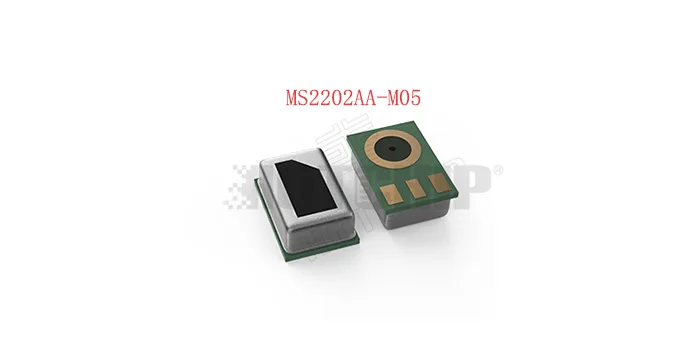
The ultra‑miniature package of the MS2202AA‑M05 – just 3.35 mm × 2.50 mm × 1.00 mm – fits perfectly within the extremely limited internal space of atomizers. Compared to traditional solutions, it saves at least 30% of PCB area, freeing up valuable space for larger batteries, upgraded chips, or additional functional modules.
Acoustic Characteristics Precisely Matched
Triggering an atomizer requires accurate detection of the user’s inhalation while rejecting ambient noise. The MS2202AA‑M05 is specially tuned:
– Enhanced low‑frequency response (100–500 Hz range) to more accurately capture the specific frequency signature of inhalation.
– Built‑in adaptive threshold algorithm to distinguish between environmental airflow fluctuations and intentional inhalation.
– High signal‑to‑noise ratio of 65 dB ensures reliable operation even in noisy environments.
Revolutionary Power Consumption Control
As a portable device, power management is critical for atomizers. The “smart switch” mode of the MS2202AA‑M05 is a core innovation:
– Standby power consumption below 10 µA, consuming virtually no battery power.
– Millisecond wake‑up response with no perceptible delay to the user.
– Adaptive sensitivity adjustment that optimizes recognition accuracy and power balance based on usage habits.
Enhanced Environmental Robustness
Addressing the specific demands of atomizer usage scenarios, the MS2202AA‑M05 is reinforced in multiple ways:
– Anti‑condensation design: Special membrane treatment prevents atomizer liquid condensation from affecting sensor performance.
– Wide operating temperature: −20 °C to 70 °C, covering a wide range of use environments.
– EMI immunity: Optimized shielding to avoid interference with high‑frequency PWM regulation circuits inside the atomizer.
Application Scenarios: Redefining the Atomizer Interaction Experience
Smart Triggering and False‑Trigger Prevention
By learning the user’s inhalation patterns (duration, airflow intensity, frequency characteristics), the MS2202AA‑M05 builds a personalized trigger model. Unlike simple airflow switches, it can effectively distinguish:
– Intentional deep inhalation (trigger)
– Ambient wind disturbance (no trigger)
– Light test inhalation (trigger or not depending on configuration)
– Consecutive rapid inhalations (can activate protection mechanisms)
Usage Habit Analysis and Feedback
Modern atomizers are not just nicotine delivery devices but also personal health management tools. The MS2202AA‑M05 accurately records:
– Single‑use duration and inhalation volume.
– Daily/weekly usage frequency statistics.
– Inhalation intensity pattern analysis.
This data can be transmitted via Bluetooth to a mobile app, providing users with usage insights and moderation suggestions.
Enhanced Safety Protection Mechanisms
Combined with MCU algorithms, the MS2202AA‑M05 enables multiple layers of safety protection:
– Continuous abuse prevention: Automatically limits output when detecting high‑frequency consecutive use.
– Child lock: Activated/deactivated by specific inhalation pattern sequences.
– Abnormal use alert: Recognizes unusually intense inhalation patterns to prevent device overload.
Buttonless Integrated Design
Atomizers using the MS2202AA‑M05 can achieve a completely buttonless, seamless exterior:
– Improved water and dust resistance (up to IP67).
– Simplified assembly process, lowering production costs.
– Smooth, uninterrupted aesthetics – especially favored in high‑end product lines.
Manufacturing Advantages: Tailored for Volume Production of Atomizers
Full Automation Assembly Compatibility
The MS2202AA‑M05 comes in a standard SMT package and can be assembled together with the atomizer’s main control chip and power management IC using fully automatic pick‑and‑place machines, significantly improving production efficiency. Compared to manual installation required for mechanical buttons, production speed is increased by more than three‑fold, with notably better consistency.
Reliability Testing and Validation
Hotchip has conducted specialized reliability validation for the MS2202AA‑M05 according to the specific requirements of the atomizer industry:
– 500,000‑cycle inhalation simulation – no performance degradation.
– High‑low temperature cycling – 500 cycles from −20 °C to 70 °C.
– Accelerated condensation aging test – simulating long‑term use in high‑humidity environments.
– Drop and vibration tests – meeting the usage intensity requirements for portable devices.
Localized Supply Chain Advantages
As an independently developed domestic product, the MS2202AA‑M05 avoids supply risks arising from international trade uncertainties. Hotchip has manufacturing bases in Shenzhen and Dongguan, offering:
– Flexible minimum order quantities (MOQ).
– Fast sample support (3–5 working days).
– Customized parameter tuning services.
– On‑site support from local technical teams.
Design Guidelines: Optimizing Atomizer Solutions with the MS2202AA‑M05
Key Acoustic Structure Design Points
1. Air intake path optimization: Design a dedicated acoustic channel connecting the air intake to the microphone. Recommended channel diameter 1.2–1.5 mm, length ≤5 mm, avoiding sharp turns.
2. Wind noise prevention: Add a micro‑labyrinth structure in the acoustic path to reduce direct impact of ambient wind on the microphone diaphragm.
3. Contamination barrier: Place a replaceable dust filter in front of the microphone to prevent deposition of e‑liquid particles.
Circuit Design Recommendations
1. Power isolation: Provide an independent LDO power supply for the MS2202AA‑M05 to avoid interference with the power output circuit.
2. Signal routing: Keep audio signal lines away from high‑frequency PWM traces; use ground shielding where necessary.
3. Grounding strategy: Use star grounding to prevent digital noise from coupling into the analog section through the ground loop.
Algorithm Integration Solutions
Hotchip provides an algorithm library optimized specifically for atomizers, including:
– Basic trigger algorithm: Ready‑to‑use core inhalation recognition.
– Adaptive learning module: Automatically optimizes trigger thresholds based on user habits.
– Safety protection algorithms: Over‑inhalation protection, child lock, and other safety functions.
– Data statistics module: Basic framework for usage data collection and analysis.
Customers can choose different algorithm combinations based on product positioning to balance feature richness and cost control.
Comparative Analysis: Performance Differences Between MS2202AA-M05 and Traditional Solutions
| Performance Metric | Traditional Airflow Sensor | Mechanical Micro Switch | MS2202AA-M05 |
| Trigger accuracy | 75–85% | 95%+ | 98%+ (with algorithm optimization) |
| False trigger rate | 15–25% | <5% | <2% |
| Service life | ~100k cycles | ~500k cycles | >1,000k cycles |
| Environmental robustness | Poor (sensitive to temperature/humidity) | Moderate | Excellent |
| Water/dust resistance | Moderate | Poor | Excellent (IP67 capable) |
| Power consumption | 10–50µA | 0 (passive) | <10µA (standby) |
| Intelligence potential | None | None | Rich |
| Assembly complexity | Moderate | High (manual) | Low (fully automatic) |
| Overall cost | Low | Moderate | Moderate (but high added value) |
Industry Trends: Atomizer Intelligence and the Opportunity for MS2202AA-M05
Regulation‑Driven Technological Innovation
As global atomizer regulations tighten, higher requirements are placed on product safety and controllability. The intelligent control capabilities of the MS2202AA‑M05 directly address these needs:
– Age verification: Assisted age recognition through inhalation pattern analysis.
– Dosage control: Precise calculation of nicotine intake with daily upper limits.
– Regional compliance adjustment: Remote device parameter adjustment according to local regulations.
Differentiation Amid Consumer Upgrade Trends
In a highly homogenized atomizer market, intelligence has become a key differentiator. Products integrating the MS2202AA‑M05 can deliver:
– Personalized experience: Learning user habits and automatically adjusting output curves.
– Social features: Usage data sharing, challenge modes, etc., to enhance user engagement.
– Health management: Integration with health apps for comprehensive nicotine intake management.
Future Technology Convergence
As a smart entry point, the MS2202AA‑M05 can be combined with other sensors to create even more possibilities:
– With gyroscope: Recognizing device orientation to automatically adjust output power.
– With temperature sensor: Preventing overheating and optimizing atomization efficiency.
– With haptic feedback: Providing inhalation‑confirmation vibration feedback.
Success Stories: Real‑World Application of MS2202AA-M05 in Atomizer Products
High‑End Business Series Atomizer
A well‑known brand adopted the MS2202AA‑M05 in its flagship product, achieving:
– A completely buttonless, all‑metal unibody design with minimalist, premium aesthetics.
– Smart inhalation recognition that automatically matches the optimal power based on inhalation intensity.
– Usage data synced to a mobile app, providing weekly usage reports.
– Activation of cleaning mode via a specific inhalation sequence.
After launch, this product gained over 30% share growth in the high‑end market.
Entry‑Level Pod Atomizer
For cost‑sensitive markets, Hotchip offers a streamlined solution that retains core trigger functionality while optimizing cost structure:
– Simplified algorithm, retaining basic trigger and false‑trigger prevention.
– Simplified package to reduce BOM cost.
– Standardized parameters to minimize tuning requirements.
This solution helps customers significantly improve product reliability and user experience while maintaining competitive pricing.
Implementation Roadmap: From Evaluation to Mass Production
Phase 1: Evaluation and Testing (1–2 weeks)
1. Obtain the MS2202AA‑M05 evaluation kit.
2. Conduct basic functional validation (trigger accuracy, response time).
3. Test under simulated real‑world usage scenarios.
Phase 2: Prototype Development (3–4 weeks)
1. Integrate the MS2202AA‑M05 into the existing atomizer platform.
2. Tune the acoustic structure and algorithm parameters.
3. Complete initial reliability testing.
Phase 3: Small‑Batch Trial Production (4–6 weeks)
1. Produce 200–500 trial units.
2. Conduct user experience testing and collect feedback.
3. Refine design details and production processes.
Phase 4: Mass Production Preparation (2–3 weeks)
1. Complete all certification tests (CE, FCC, RoHS, etc.).
2. Establish production line test fixtures and standards.
3. Define quality control procedures.
Hotchip provides full technical support throughout the process, from technical consultation to production ramp‑up, ensuring a smooth product upgrade for customers.
Small Sensor, Big Transformation
On the path of atomizer evolution from “functional” to “user‑friendly” to “intelligent,” the MS2202AA‑M05 represents a fundamental shift: from passive response to smart sensing, from single‑function to multi‑dimensional interaction, and from general‑purpose components to scenario‑specific optimization.
This MEMS switch microphone, purpose‑built for atomizers, not only solves the pain points of traditional trigger solutions but also opens new spaces for product innovation. It enables atomizers to “understand” user intent, learn usage habits, deliver personalized experiences, and reach new heights in safety and compliance.
With the MS2202AA‑M05, Hotchip demonstrates the ability of Chinese semiconductor companies to innovate deeply in niche markets. This product is not a simple technology transplant; it is targeted R&D and optimization based on profound understanding of atomizer usage scenarios.
For atomizer brands, integrating the MS2202AA‑M05 is not just a technical upgrade – it is a strategic repositioning. In an increasingly competitive market, such a differentiation strategy based on core technology may well determine success or failure.In the world of miniature sensors, the MS2202AA‑M05 may be tiny, but it is driving a massive transformation toward intelligence in the entire atomizer industry. This transformation has just begun, and brands that choose to enter now will have the opportunity to define the next generation of atomizer product form and user experience standards.